At a Glance
The great white shark (Carcharodon carcharias) is a large mackerel shark found along temperate coasts of every continent except Antarctica. A typical adult is about 4 to 5 m long and weighs roughly 700 to 1,100 kg, with big females reaching about 6 m. It hunts marine mammals and large fish with rows of serrated, triangular teeth and is listed as vulnerable.
- Animal type
- Cartilaginous fish (mackerel shark family)
- Typical length
- 4–5 m; large females about 6 m
- Typical weight
- About 700–1,100 kg
- Diet
- Seals, sea lions, fish, rays, dead whales
- Home
- Cool and temperate coastal seas, open ocean on migration
- Top burst speed
- About 40 km/h (25 mph)
- Lifespan
- 70 years or more
On this page
- What Is a Great White Shark?
- Facts and classification
- How Big Is a Great White Shark?
- What Does a Great White Shark Look Like?
- How Many Teeth Does a Great White Shark Have?
- Where Do Great White Sharks Live?
- What Do Great White Sharks Eat?
- How Do Great White Sharks Behave?
- How Do Great White Sharks Reproduce?
- How Long Do Great White Sharks Live, and What Eats Them?
- Great White Shark vs Orca, Bull Shark and Crocodile
- Are Great White Sharks Dangerous to Humans?
- Are Great White Sharks Endangered?
- Where to See the Great White Shark in the US
- Where to See the Great White Shark Around the World
- Fun facts
- Key Facts
- Quiz
- FAQ
What Is a Great White Shark?
A great white shark is a large, warm-bodied predatory shark in the mackerel shark family, the same group as the shortfin mako and the salmon shark. It is the only living member of its genus, Carcharodon, and it is often called simply the white shark or white pointer.
Its fame comes from a mix of real power and film-made fear. Great whites are the biggest fish that regularly hunt warm-blooded prey, and a fully grown female can outweigh a small car. Yet they spend most of their time cruising quietly, investigating rather than attacking, and they play a key role keeping seal and sea lion numbers in balance.
Like every shark, a great white has a skeleton made of cartilage rather than bone, five gill slits on each side of the head and skin covered in tiny tooth-like scales. It must keep moving forward to push water over its gills, so it rarely rests in one spot.
Great white shark Facts and Classification
| Common name | Great white shark |
|---|---|
| Scientific name | Carcharodon carcharias |
| Kingdom | Animalia |
| Phylum | Chordata |
| Class | Chondrichthyes (cartilaginous fish) |
| Order | Lamniformes |
| Family | Lamnidae |
| Genus | Carcharodon |
| Adult weight | 1,090 kg |
| Lifespan | 73 years |
| Conservation status | Vulnerable |
| U.S. states with records | 3 of 50 |
| Countries with records | 19 |
| Typical length | 4–5 m (13–16 ft); females larger than males (typical adult, our editors) |
| Typical weight | About 700–1,100 kg (typical adult, our editors) |
| Teeth in the jaws | About 300, in several rows (typical count, our editors) |
| Burst speed | About 40 km/h (typical maximum, our editors) |
Sources: Wikidata, GBIF
How Big Is a Great White Shark?
Most adult great whites are about 4 to 5 m long, roughly the length of a family SUV. Females grow larger than males: mature males usually stop at around 3.5 to 4 m, while large females reach about 5.5 to 6 m. Weights of 700 to 1,100 kg are typical for adults, and the heaviest females, full of food before a migration, can pass 2,000 kg.
Next to a person, a typical adult is nearly three times as long as a standing human is tall, and its body is wide enough that a diver can fit inside the outline of its belly from side to side. Compared with an orca, though, it is smaller: an adult male orca is usually longer and several times heavier, which helps explain why orcas sometimes hunt great whites.
Stories of 8 or 10 m great whites appear often, but none has held up when measured carefully. A shark close to 6 m and well over a tonne is already an exceptional animal. Pups are born at about 1.2 to 1.5 m long, already larger than many adult shark species.

What Does a Great White Shark Look Like?
The great white has a heavy, spindle-shaped body that is thickest in the middle and tapers to a pointed, cone-shaped snout. Its back and sides are slate gray to bronze-gray, and the underside is bright white, with a sharp, uneven line where the two colors meet. Seen from above, the dark back blends with deep water; seen from below, the pale belly blends with the bright surface. This color pattern is called countershading.
The first dorsal fin is tall and triangular, the classic fin that cuts the surface in films. The pectoral fins are long and stiff, often with dark tips underneath. The tail is shaped like a crescent moon, with upper and lower lobes almost the same size, and a ridge called a keel runs along each side of the tail stalk to steady it at speed.
How to tell a great white from similar sharks
- Shortfin mako: slimmer and bright metallic blue on the back, with long, thin, smooth teeth that show even when the mouth is closed.
- Salmon shark: much smaller and stockier, with dark blotches on a white belly; it lives in the cold North Pacific.
- Bull shark: shorter and chunkier with a blunt, rounded snout, a smaller first dorsal fin and an uneven tail with a much longer upper lobe.
- Basking shark: larger but harmless, with enormous gill slits that almost circle the head and a wide open mouth for filtering plankton.
How Many Teeth Does a Great White Shark Have?
A great white carries about 300 teeth at any one time, set in several rows. Only the front one or two rows are in use; the rows behind lie flat and move forward like a slow conveyor belt to replace teeth that break or fall out. A single shark can shed thousands of teeth over its lifetime, which is why fossil and beach-found shark teeth are so common.
The upper teeth are broad, flat triangles with saw-like edges, made for slicing chunks out of blubber and muscle. The lower teeth are narrower and pointier, used to grip prey while the upper jaw cuts. When it bites, the shark pushes its upper jaw forward and shakes its head from side to side to saw through flesh.
Senses
Great whites use every sense in turn as they close in. They smell blood and oils from far away, pick up vibrations with a sensory line along each side of the body, and see well in dim water. In the last moments of an attack, small jelly-filled pores on the snout detect the weak electric fields made by a living animal's muscles, guiding the bite even when the eyes are rolled back for protection.
Where Do Great White Sharks Live?
Great whites live in cool to warm-temperate seas worldwide, mostly over the continental shelf within a few dozen kilometers of the coast. The best-known gathering places are off central California and Baja California, South Africa, southern and western Australia, New Zealand, and in recent years the waters of Cape Cod in Massachusetts. Smaller numbers live in the Mediterranean Sea, around Japan and off Chile.
They favor water of about 12 to 24 °C, often near seal and sea lion colonies on rocky islands. Young great whites stay in shallower, warmer nursery areas, such as the beaches of Southern California and the Gulf of California, where they feed mostly on fish and rays.
Tags fixed to great whites have shown that adults are long-distance travelers. Some sharks from California swim out to a remote patch of the central Pacific each winter and spring, and one South African female crossed to Australia and back within a year. On these journeys they dive to depths of several hundred meters and sometimes more than 1,000 m.

What Do Great White Sharks Eat?
Young great whites eat mostly fish, rays and smaller sharks. As they pass about 3 m in length, their jaws and teeth grow strong enough to handle marine mammals, and seals, sea lions and elephant seals become the main menu. Along the U.S. Pacific coast, California sea lions and northern elephant seals are classic prey. Great whites also feed on dolphins, sea turtles, seabirds and, very often, the floating carcasses of dead whales.
Their favorite tactic is an ambush from below. The shark patrols deep water near a seal colony, watches the silhouette of a swimming seal against the bright surface, then rushes straight up. In places such as South Africa, the attack is so fast that the shark bursts completely out of the water, a behavior called breaching.
After a big first bite, a great white often lets go and waits a short distance away while the prey weakens, then returns to feed. A large meal of blubber is rich in energy, and an adult can go weeks between big feeds.

How Do Great White Sharks Behave?
Great whites are mostly solitary, but they are not loners in the strict sense. At seal colonies, several sharks may hunt the same area and sort themselves out by size, with smaller sharks giving way to bigger ones through body language such as swimming side by side, arching the back or slapping the tail at the surface.
They are curious animals. A great white often investigates an unfamiliar object by circling it, lifting its head above the water to look around, or taking a gentle test bite with its teeth, since it has no hands to explore with. That habit lies behind many bites on surfboards, kayaks and, sadly, people.
Great whites are unusual among sharks because they keep their swimming muscles, eyes, brain and stomach warmer than the surrounding sea, sometimes by more than 10 °C. A network of blood vessels traps heat made by the muscles. This gives them extra speed and lets them hunt actively in cold water where seals live.
How Do Great White Sharks Reproduce?
Great whites grow slowly and start breeding late. Males mature at around 26 years of age, and females at around 33 years, which is one of the latest starts of any fish. Mating has almost never been seen, but fresh bite scars on females suggest males grip them with their teeth during courtship.
The female does not lay eggs. The young hatch from egg capsules inside her body and keep growing there, feeding on extra unfertilized eggs she produces. Pregnancy is thought to last more than a year, and a litter usually holds about 2 to 10 pups.
The pups are born fully formed in warm, shallow nursery waters and receive no care from their mother. They are on their own from the first minute, eating fish and dodging bigger sharks. Because females breed only every two or three years and produce few young, great white numbers recover very slowly once they fall.
How Long Do Great White Sharks Live, and What Eats Them?
Great whites are long-lived. Studies that read growth bands in their backbones, checked against traces of nuclear-test carbon laid down in the 1950s and 1960s, show that some males live more than 70 years. A great white seen today could have been born before the first moon landing.
Fully grown great whites have only one natural predator: the orca. Off California and South Africa, groups of orcas have killed great whites and eaten their fat-rich livers, and in the weeks after such attacks the surviving sharks abandon the area. Read more on great white shark vs orca.
Young great whites can be eaten by larger sharks, including bigger great whites. The main threat to the species, however, comes from people: accidental capture in fishing gear, nets set to protect beaches, and in the past, trophy fishing and trade in jaws and fins.

Great White Shark vs Orca, Bull Shark and Crocodile
People often match the great white against other big predators. Here is how it stacks up, based on size and what scientists have actually observed.
- Great white vs orca: the orca wins. It is bigger, smarter and hunts in coordinated groups, and real attacks on great whites have been recorded several times.
- Great white vs bull shark: an adult great white is roughly five times as heavy as an adult bull shark. The two rarely meet, because bull sharks prefer warm, shallow and even fresh water.
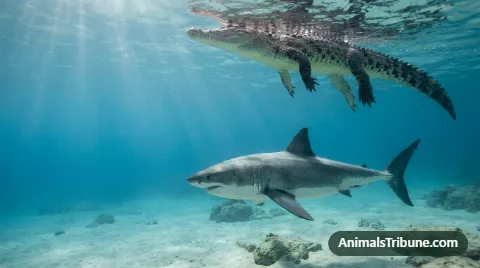
- Great white vs saltwater crocodile: the crocodile is deadly at the water's edge, but in open sea the larger, faster shark would hold the advantage. Their ranges barely overlap. See great white shark vs saltwater crocodile.
- Great white vs megalodon: the extinct megalodon was in a different league, at roughly two to three times the length and many times the weight of a great white.
| Animal | Typical adult length | Typical adult weight | Main prey |
|---|---|---|---|
| Great white shark | 4–5 m | 700–1,100 kg | Seals, sea lions, fish |
| Orca | 6–8 m | 3,500–6,000 kg | Fish, seals, whales, sharks |
| Bull shark | 2–3.5 m | 90–230 kg | Fish, rays, other sharks |
| Shortfin mako shark | 2.5–3.5 m | 60–150 kg | Tuna, swordfish, squid |
| Saltwater crocodile | 4–5 m (males) | 400–1,000 kg | Fish, mammals, birds |
| Source: Typical values, our editors · Retrieved October 2026 | |||
Are Great White Sharks Dangerous to Humans?
Great whites are responsible for more recorded unprovoked bites on people than any other shark, and they are near the top of the deadliest sharks. Still, bites are rare. Worldwide, great whites are linked to only a handful of bites in a typical year, while millions of people swim, surf and dive in waters where they live.
Most bites appear to be cases of mistaken identity or curiosity. A surfer paddling on a board can look like a seal from below, and many victims are bitten once and released. The shark's real interest is energy-rich blubber, which people do not have.
Simple habits lower the risk further: avoid swimming near seal colonies, at dawn and dusk, or in murky water, stay in groups, and follow local beach warnings and shark-spotting flags.
Are Great White Sharks Endangered?
Great white sharks are listed as vulnerable, one step below endangered. They are naturally scarce top predators with slow breeding, so even modest losses add up. Exact global numbers are unknown, but studies at well-watched sites suggest populations of a few hundred to a few thousand adults per region.
The good news is that protection works. The species is protected in U.S. waters, Australia, South Africa and many other countries, and international trade in great white products is controlled. Off California and the northeastern United States, sightings have climbed for years, helped by the recovery of seal populations that great whites depend on.
As an apex predator, the great white keeps seal colonies healthy by removing sick and weak animals and changes where prey choose to feed, which ripples through the whole coastal ocean food web.
Where to See the Great White Shark in the US
Recorded wildlife sightings place the great white shark in 3 U.S. states (at least 5 sightings each). Most sightings at sea are logged without a state, so these state counts are a minimum. Each state page lists the related animals recorded there.
- Sharks in California 84 sightings
- Sharks in Florida 8 sightings
- Sharks in Massachusetts 8 sightings
Explore more: Sharks in the US · Shark · Fish
Where to See the Great White Shark Around the World
The countries outside the US with the most recorded sightings of the great white shark (at least 5 sightings each). Linked countries have their own page about the animals recorded there.
- Sharks in Australia 11,038 sightings
- Sharks in New Zealand 1,691 sightings
- Sharks in South Africa 177 sightings
- New Caledonia 148 sightings
- Norfolk Island 129 sightings
- Sharks in the UK 47 sightings
- Vanuatu 43 sightings
- Sharks in Canada 24 sightings
- Sharks in Mexico 24 sightings
- Sharks in Japan 22 sightings
- Tonga 21 sightings
- French Southern Territories 14 sightings
Explore more: Sharks Around the World · Animals by Country
10 Fun Facts About the Great white shark
- A great white can launch its whole body out of the water while chasing a seal.
- It often lifts its head above the surface to look around, a behavior called spy-hopping.
- Great whites roll their eyes back into their sockets just before biting to protect them.
- A single shark can lose and replace thousands of teeth in its lifetime.
- Pups are born at more than 1.2 m long, bigger than many adult sharks.
- Tagged great whites from California travel to a lonely spot in the middle of the Pacific every year.
- Its liver can make up roughly a quarter of its body weight and stores oil for long journeys.
- Orcas hunt great whites mainly for their energy-rich livers.
- No great white has survived long in an aquarium; they do poorly in captivity.
- Each great white's dorsal fin has a unique notched edge that researchers use like a fingerprint.
Key Facts
- The great white shark is the largest predatory fish, typically 4 to 5 m long and 700 to 1,100 kg.
- Females are larger than males and can reach about 6 m.
- It carries about 300 serrated teeth in rows that are replaced throughout life.
- It keeps its muscles and brain warmer than the surrounding water, which helps it hunt in cold seas.
- Adults feed mainly on seals and sea lions, often ambushing them from below.
- Great whites can live more than 70 years but do not breed until their late 20s or early 30s.
- The species is listed as vulnerable and is protected in many countries.
Quick Quiz: How Well Do You Know the Great white shark?
6 questions. Tap an answer to check it.
What is a great white shark's skeleton made of?
Like all sharks, the great white has a skeleton of flexible cartilage.
Which great whites grow larger?
Females are larger, reaching about 6 m, while males usually stop near 4 m.
What is the main food of adult great whites?
Adults hunt marine mammals such as seals and sea lions for their energy-rich blubber.
Which animal is known to hunt adult great white sharks?
Orcas have killed great whites in several places and eat their livers.
About how old can great white sharks get?
Growth bands in the backbone show that some great whites live more than 70 years.
What is it called when a great white leaps fully out of the water?
Breaching is the leap that often happens during a fast attack from below.
Frequently Asked Questions
How big is a great white shark?
A typical adult great white is about 4 to 5 m long and weighs about 700 to 1,100 kg. Males are smaller, usually 3.5 to 4 m, while large females reach around 6 m and sometimes weigh more than 2,000 kg.
How big is a great white shark compared to a human?
An average adult great white is nearly three times as long as a standing adult is tall and more than ten times as heavy. Even a newborn pup, at about 1.2 to 1.5 m, is close to the height of a young child.
Is a great white shark bigger than an orca?
No. An adult orca is usually 6 to 8 m long and weighs several tonnes, which makes it longer and much heavier than a great white. Orcas are also the only animals known to hunt adult great whites.
How many teeth does a great white shark have?
About 300 at a time, arranged in several rows. The front rows do the work, while the rows behind move forward to replace lost teeth, so a great white never runs out over its life.
Where do great white sharks live?
They live in cool to warm-temperate coastal seas around the world. Well-known hotspots include California and Mexico's Pacific coast, South Africa, southern Australia, New Zealand and Cape Cod in the northeastern United States.
What do great white sharks eat?
Young great whites eat fish, rays and small sharks. Adults switch mainly to seals, sea lions and elephant seals, and they also eat dolphins, sea turtles, seabirds and the carcasses of dead whales.
Is a great white shark the same as a white shark?
Yes. White shark, great white shark and white pointer are different common names for the same species, Carcharodon carcharias. Many scientists simply say white shark.
How fast can a great white shark swim?
It usually cruises slowly, at a walking pace, to save energy. In a short attack burst it can reach about 40 km/h (25 mph), fast enough to leap clear of the water when striking a seal from below.
Are great white sharks endangered?
They are listed as vulnerable, meaning they face a high risk of decline in the wild. Slow breeding makes them sensitive to fishing, but protection in the United States, Australia, South Africa and other countries has helped some populations grow.