
At a Glance
African elephants are two species in the genus Loxodonta: the African bush elephant and the African forest elephant. Bush elephant bulls stand about 3 to 4 m at the shoulder and weigh around 6,000 kg, making them the largest land animals, while forest elephants are noticeably smaller. Both sexes usually have tusks, and both species are listed as threatened by poaching and habitat loss.
- Animal type
- Mammal, order Proboscidea
- Living species
- 2: African bush elephant and African forest elephant
- Size
- Bush elephant bulls about 3 to 4 m tall, around 6,000 kg
- Diet
- Grasses, leaves, bark, roots and fruit
- Social life
- Family herds led by an older female, the matriarch
- Pregnancy
- About 22 months, the longest of any mammal
- Found
- Sub-Saharan Africa
On this page
- What Is an African Elephant?
- Facts and classification
- Types of African Elephants: Bush and Forest
- How Big Are African Elephants?
- Trunks, Tusks and Ears
- What Do African Elephants Eat?
- Herds, Communication and Intelligence
- Life Cycle and Lifespan
- Where Do African Elephants Live?
- Are African Elephants Endangered?
- African Elephant vs Asian Elephant
- The full list
- Fun facts
- Key Facts
- Quiz
- FAQ
What Is an African Elephant?
The name African elephant covers the elephants of the genus Loxodonta, which live only in Africa south of the Sahara. They belong to the order Proboscidea, the trunk-bearers, a group that once included mammoths, mastodons and dozens of other species. Today only three elephant species survive: two in Africa and one in Asia.
For most of the 20th century, scientists treated all African elephants as a single species. Studies of their skulls, behavior and especially their DNA showed that savanna and rainforest elephants have been evolving separately for a very long time, and most experts now recognize them as two species.
African elephants are a classic example of a keystone species. By pushing over trees, digging for water and spreading seeds in their dung, they create open grassland, waterholes and new forest that many other animals rely on.
African elephant Facts and Classification
| Common name | African elephant |
|---|---|
| Scientific name | Loxodonta |
| Kingdom | Animalia |
| Phylum | Chordata |
| Class | Mammalia (mammals) |
| Order | Proboscidea |
| Family | Elephantidae |
| Living species | 2 (current classification, our editors) |
| Bush elephant bull | About 3 to 4 m at the shoulder, around 6,000 kg (typical large adult male, our editors) |
| Forest elephant bull | About 2.4 to 3 m at the shoulder, roughly 2,500 to 4,000 kg (typical adult male, our editors) |
| Food per day | About 100 to 150 kg (typical adult, our editors) |
Sources: Wikidata, GBIF
Types of African Elephants: Bush and Forest
The two species differ in size, shape and lifestyle:
- African bush elephant (Loxodonta africana): the larger species, found on savannas, grasslands, floodplains and dry woodlands from East Africa to southern Africa. Its ears are huge and roughly triangular, and its tusks curve outward and up.
- African forest elephant (Loxodonta cyclotis): smaller and more compact, living in the dense rainforests of Central and West Africa. Its ears are rounder, and its tusks are thinner and straighter, pointing down so they do not snag on vines.
Forest elephants live in smaller family groups, eat much more fruit and are harder to count, since they hide in thick vegetation. Where the two species meet at the forest edge, they occasionally interbreed.
The bush elephant is listed as endangered and the forest elephant as critically endangered, because forest elephant numbers have fallen especially sharply in recent decades.

How Big Are African Elephants?
A full-grown bush elephant bull is the heaviest animal walking on land. A typical big male stands about 3 to 4 m at the shoulder, as tall as a basketball hoop or taller, and weighs around 6,000 kg, more than two full-size pickup trucks put together. Cows are much smaller, at about 2.5 m and 3,000 kg.
Forest elephants are the smaller cousins. Bulls usually stand about 2.4 to 3 m tall and weigh roughly 2,500 to 4,000 kg, while adult females are often closer to 2 m.
Elephants grow for most of their lives. Bulls in particular keep putting on height and weight into their thirties and forties, so the biggest elephants in any herd are usually the oldest males. The chart below puts both African species beside an Asian elephant and a person.

Trunks, Tusks and Ears
The trunk is a fusion of the nose and upper lip, with no bones and tens of thousands of muscle bundles. An African elephant uses it to breathe, smell, drink, trumpet, greet relatives and grab food, and the two finger-like tips at the end can pick up a single seed. When drinking, an elephant sucks water partway up the trunk and then squirts it into its mouth, several liters at a time.
Tusks are long, ever-growing incisor teeth made of ivory. In African elephants, both males and females usually have them, although tuskless elephants have become more common in areas with heavy poaching. Elephants use tusks to dig for water and salt, strip bark, move branches and fight.
The giant ears are radiators as much as hearing organs. They are thin and full of blood vessels, so flapping them cools the blood before it returns to the body. That matters in the African heat, because a body this large builds up warmth far faster than it can lose it.
What Do African Elephants Eat?
African elephants are herbivores with an enormous appetite. An adult eats about 100 to 150 kg of food a day and may spend 16 or more hours feeding. Bush elephants graze on grass in the wet season and switch to leaves, bark, twigs, roots and seed pods in the dry season. Forest elephants eat large amounts of fruit, along with leaves and bark.
An elephant digests less than half of what it eats, so it leaves behind huge amounts of dung packed with seeds. Many rainforest trees depend on forest elephants to carry their seeds far from the parent tree, and some seeds sprout better after passing through an elephant.
Elephants also need a lot of water, often 100 liters or more a day. In dry riverbeds they dig holes with their feet, trunks and tusks to reach water below the sand, and those holes then serve zebras, antelopes and birds as well.
Herds, Communication and Intelligence
African elephant society is built around females. A family herd is usually a group of related mothers, daughters, sisters and young, led by the oldest and most experienced female, the matriarch. She remembers where to find water in a drought and which routes are safe, and her knowledge can decide whether a family survives a hard year.
Young males leave the family as teenagers and live alone or in loose bachelor groups. Adult bulls enter a yearly state called musth, when their hormone levels rise, a dark fluid runs from glands on the sides of the head, and they become restless and aggressive as they look for mates.
Elephants communicate with rumbles so deep that people can barely hear them. These low sounds travel several kilometers through the air and the ground, and elephants seem to pick up the vibrations through their feet and trunk. They also recognize the voices of dozens of relatives, react to the bones of dead elephants and show signs of strong family bonds.
Life Cycle and Lifespan
Elephant pregnancy lasts about 22 months, longer than in any other mammal. A newborn calf weighs around 100 kg and can stand within an hour. It drinks its mother's milk for about two years and is cared for by the whole family, including aunts and older sisters who act as babysitters.
Females usually have their first calf in their early to mid teens and then one calf about every four to five years. This slow pace means elephant populations take a long time to recover after heavy losses.
Wild African elephants can live for 60 to 70 years. Late in life, their last set of molars wears down, and an old elephant may struggle to chew enough food. Elephants go through six sets of large grinding teeth over a lifetime, each set moving forward like a conveyor belt.
Where Do African Elephants Live?
African elephants live in about three dozen countries of sub-Saharan Africa. Bush elephants are most numerous in southern and eastern Africa, in countries such as Botswana, Zimbabwe, Tanzania, Kenya, Zambia and South Africa, where many live in national parks and large conservation areas. Forest elephants live in the Congo Basin and in scattered forests of West Africa.
Their habitats range from desert edges in Namibia and Mali to mountain forests, swamps and coastal woodland. Elephants follow the rains and the food, and some herds migrate long distances between wet-season and dry-season ranges.
Today their range is broken into patches separated by farms, roads and towns. Wildlife corridors that link one protected area to another are an important part of conservation plans.

Are African Elephants Endangered?
Yes. Both species are listed as threatened: the bush elephant as endangered and the forest elephant as critically endangered. Total numbers across Africa are estimated at a few hundred thousand, far fewer than a century ago.
The main threat has long been poaching for ivory. Waves of illegal killing in the 1970s and 1980s and again in the 2000s and 2010s wiped out elephants across large areas. International trade in new ivory is banned, but illegal markets still exist.
Loss of habitat is now just as serious. As farms spread into elephant range, elephants raid crops and come into conflict with people. Projects that use fences, chili-pepper barriers, beehive fences and community wildlife income are helping farmers and elephants share the land.
African Elephant vs Asian Elephant
The Asian elephant is a separate genus, Elephas, and a few clues tell them apart at a glance. African elephants have much larger ears, a back that dips in the middle, a single rounded dome on the head and two finger-like tips on the trunk. Asian elephants have smaller ears, a rounded or level back, a head with two bumps and one tip on the trunk.
Tusks help too. Both male and female African elephants usually have tusks, while most female Asian elephants and many males do not. African bush elephants are also larger. Our African vs Asian elephant and African vs Indian elephant pages compare them side by side.
Extinct relatives make good comparisons as well. The woolly mammoth was about the same height as an African bush elephant, while some other mammoths and the American mastodon were built more heavily.


African Elephants and Their Relatives on Our Site (8)
The two African species come first, followed by their closest living and extinct relatives. Tap a card for more facts, size and range.
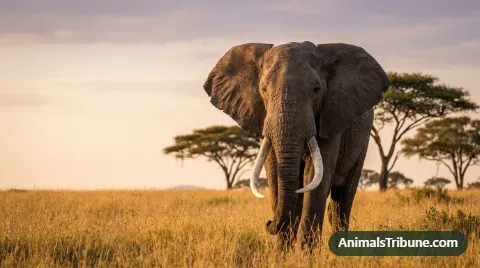 African bush elephantLoxodonta africanaLargest land animal, savannas and woodland
 African forest elephantLoxodonta cyclotisSmaller rainforest species of Central and West Africa
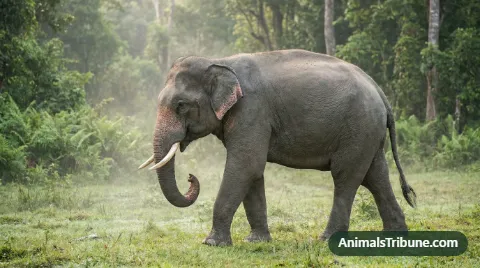 Asian elephantElephas maximusThe only other living elephant species
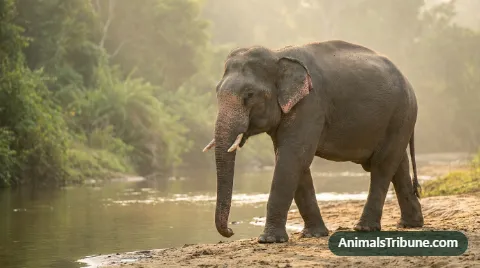 ElephantsElephantidaeAll elephants, living and extinct
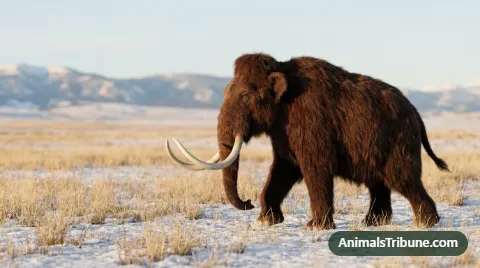 Woolly mammothMammuthus primigeniusIce age relative with a shaggy coat
 MastodonMammutExtinct trunked mammal of North America
 Rock hyraxProcavia capensisA small, surprising living relative of elephants
 ManateeTrichechusSea cow, another distant living relative
| African bush elephant | Loxodonta africana | Elephantidae | n/a | Endangered |
|---|---|---|---|---|
| African forest elephant | Loxodonta cyclotis | Elephantidae | n/a | Critically Endangered |
| Asian elephant | Elephas maximus | Elephantidae | n/a | Endangered |
| Elephants | Elephantidae | Elephantidae | n/a | n/a |
| Woolly mammoth | Mammuthus primigenius | Elephantidae | n/a | n/a |
| Mastodon | Mammut | Mammutidae | 7,800 kg | n/a |
| Rock hyrax | Procavia capensis | Procaviidae | n/a | Least Concern |
| Manatee | Trichechus | Trichechidae | n/a | n/a |
| Sources: Wikidata | ||||
8 Fun Facts About the African elephant
- An African elephant's trunk has no bones at all.
- Elephants can hear and feel low rumbles from other herds several kilometers away.
- A newborn calf weighs about as much as a large adult man.
- Elephants grow six sets of molars over their lifetime.
- The shape of a bush elephant's ear is often said to resemble a map of Africa.
- Elephants coat themselves with dust and mud as sunscreen and insect repellent.
- Many rainforest tree seeds sprout best after passing through a forest elephant.
- Elephants are good swimmers and use the trunk like a snorkel.
Key Facts
- There are two African elephant species: the African bush elephant and the African forest elephant.
- The bush elephant is the largest land animal, with big bulls around 6,000 kg.
- Both male and female African elephants usually have tusks.
- An adult eats about 100 to 150 kg of plants a day.
- Family herds are led by the oldest female, called the matriarch.
- Elephant pregnancy lasts about 22 months, the longest of any mammal.
- The bush elephant is listed as endangered and the forest elephant as critically endangered.
Quick Quiz: How Well Do You Know the African elephant?
6 questions. Tap an answer to check it.
How many species of African elephants are recognized today?
The African bush elephant and the African forest elephant.
Who leads an elephant family herd?
The matriarch is usually the oldest female.
How long is an elephant pregnancy?
About 22 months, the longest of any mammal.
What are an elephant's tusks?
Tusks are ever-growing incisors made of ivory.
Why do African elephants flap their ears?
Thin ears full of blood vessels release body heat.
Which African elephant is smaller and lives in rainforests?
The forest elephant lives in Central and West Africa.
Frequently Asked Questions
How many types of African elephants are there?
There are two species: the African bush elephant and the African forest elephant. They were long treated as one species, but DNA and body differences have convinced most scientists that they are separate. The bush elephant is bigger and lives on savannas; the forest elephant lives in rainforests.
How big is an African elephant?
A large African bush elephant bull stands about 3 to 4 m at the shoulder and weighs around 6,000 kg. Females are about 2.5 m tall and 3,000 kg. Forest elephants are smaller, with bulls about 2.4 to 3 m tall.
What do African elephants eat?
They eat grasses, leaves, bark, twigs, roots, seed pods and fruit. An adult needs about 100 to 150 kg of food and often 100 liters or more of water a day, so elephants spend most of their waking hours feeding.
What is the difference between an African and an Asian elephant?
African elephants have larger ears, a dipped back, two finger-like tips on the trunk and tusks in both sexes. Asian elephants have smaller ears, a rounded back, a twin-domed head, one trunk tip, and most females lack tusks. African bush elephants are also larger.
How long do African elephants live?
Wild African elephants can live for about 60 to 70 years. Old age often ends when their last set of molars wears down and they can no longer chew enough food.
Are African elephants endangered?
Yes. The African bush elephant is listed as endangered and the African forest elephant as critically endangered. Poaching for ivory and the loss of habitat to farms and settlements are the main threats.
Is an African elephant bigger than a woolly mammoth?
They were roughly the same size. Woolly mammoths stood about as tall as a modern African bush elephant, though they had shorter ears, a sloping back and a thick coat of hair. Some other mammoths, such as the Columbian mammoth, were larger.
Who leads an African elephant herd?
The herd is led by the matriarch, usually the oldest female. She guides the family to water and food, decides when to move and leads the defense against threats. Adult males live apart from these family groups.


