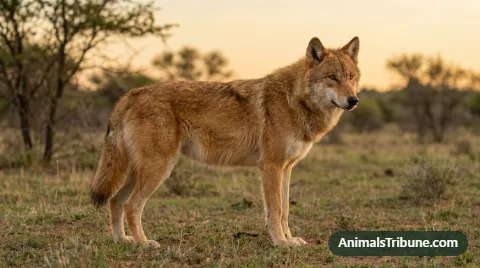
At a Glance
The gray wolf (Canis lupus) is a large wild canine that lives in family packs across the Northern Hemisphere. Adults are typically 1 to 1.6 m long plus a bushy tail, stand about 65 to 85 cm at the shoulder and weigh roughly 25 to 55 kg, with males heavier than females. Wolves hunt mainly large hoofed animals and are listed as least concern worldwide.
- Animal type
- Mammal, dog family (Canidae)
- Typical length
- 1 to 1.6 m head and body, plus a 30 to 50 cm tail
- Shoulder height
- About 65 to 85 cm
- Typical weight
- About 25 to 55 kg (55 to 120 lb)
- Diet
- Carnivore: deer, elk, moose, caribou, bison, boar, beavers, hares
- Social life
- Family packs, usually about 4 to 10 wolves
- Lifespan in the wild
- Usually about 5 to 8 years
- Range
- North America, Europe and Asia
On this page
- What Is a Wolf?
- Facts and classification
- What Does a Wolf Look Like?
- How Big Is a Wolf?
- Where Do Wolves Live?
- What Do Wolves Eat, and How Do They Hunt?
- How Do Wolf Packs Work?
- Why Do Wolves Howl?
- How Do Wolves Raise Their Pups?
- How Long Do Wolves Live, and What Threatens Them?
- Are Wolves Endangered?
- Wolf vs Dog, Coyote and Hyena
- Where to See the Wolf in the US
- Where to See the Wolf Around the World
- Fun facts
- Key Facts
- Quiz
- FAQ
What Is a Wolf?
The gray wolf is a carnivore in the genus Canis, the group that also holds the coyote, the golden jackal and the domestic dog. It is the biggest wild canine alive. Scientists recognize many regional forms of it, including the Arctic wolf of the far north, the Eurasian wolf, the small Mexican wolf and the slim desert wolves of Arabia and India.
Several other animals carry the name without being gray wolves. The red wolf of the southeastern United States and the Ethiopian wolf are separate Canis species, and the long-legged maned wolf of South America is not in Canis at all. Some scientists count the dog and the dingo as forms of Canis lupus, while others list them as species of their own.
Wolf Facts and Classification
| Common name | Wolf |
|---|---|
| Scientific name | Canis lupus |
| Kingdom | Animalia |
| Phylum | Chordata |
| Class | Mammalia (mammals) |
| Order | Carnivora |
| Family | Canidae |
| Genus | Canis |
| Lifespan | 20.6 years |
| Conservation status | Least Concern |
| U.S. states with records | 48 of 50 |
| Countries with records | 118 |
| Typical shoulder height | About 65 to 85 cm (typical adult, our editors) |
| Typical weight | About 25 to 55 kg; big northern males can pass 60 kg (typical adult, our editors) |
| Top speed | About 50 to 60 km/h (30 to 37 mph) in short bursts (typical maximum, our editors) |
| Pregnancy | About 63 days (typical values, our editors) |
Sources: Wikidata, GBIF
What Does a Wolf Look Like?
A wolf looks like a large, long-legged dog with a deep, narrow chest, big feet and a broad head. Its coat is thick and two-layered: a dense, woolly underfur for warmth and longer guard hairs that shed snow and rain. Most wolves are grizzled gray, buff and brown, but coats range from pure white in the Arctic to jet black, which is common in some North American packs.
Compared with a dog, a wolf has a longer muzzle, larger teeth, ears that stay upright and a tail that hangs straight down or is held level rather than curling over the back. Adult eyes are usually yellow to amber. The paws are wide and slightly webbed between the toes, spreading weight like snowshoes, and a large wolf's front print is roughly 10 to 13 cm long, about the size of an adult's palm.
How Big Is a Wolf?
A typical adult gray wolf stands about 65 to 85 cm at the shoulder, about as high as a kitchen counter, and is 1 to 1.6 m long from nose to rump, with a tail of 30 to 50 cm more. Weight is usually around 25 to 55 kg, close to that of a large German shepherd, and males are about a fifth heavier than females.
Size changes a lot across the range. Wolves of Alaska, Canada and Siberia are the biggest, and exceptional males there can pass 60 kg. Desert wolves of the Middle East may weigh only 15 to 25 kg. The chart compares a typical wolf with a coyote, a large dog and a person.

Where Do Wolves Live?
Wolves are among the most adaptable large mammals. They live in boreal forest, Arctic tundra, mountains, prairie, temperate woodland and even semi-desert, wherever there are enough large prey animals and enough room away from people. Historically they ranged across almost all of North America, Europe and Asia north of the tropics.
Hunting and poisoning wiped wolves out of much of that range by the mid 1900s, including most of the lower 48 United States, where a population survived in northern Minnesota. Wolves have since returned to large areas. In the United States wild packs now live in Alaska, the western Great Lakes states, the northern Rockies, the Pacific Northwest and the Southwest, and in Europe wolves have spread back into countries where they had been absent for a century or more.

What Do Wolves Eat, and How Do They Hunt?
Wolves mainly hunt hoofed animals: elk, deer, moose, caribou, bison, wild sheep and wild boar, depending on the region. They also catch beavers, hares and rodents, scavenge carcasses and in summer eat some berries. Near people they sometimes kill sheep and cattle, which is the root of most conflict with farmers.
A pack usually tests a herd by running at it, watching for an animal that is young, old, sick or slow. The chase may be long, because wolves are built for endurance more than raw speed, though they can sprint at about 50 to 60 km/h for short stretches. After a kill a hungry wolf can swallow roughly 9 kg of meat at once, and then go several days without eating.
How Do Wolf Packs Work?
A wolf pack is a family. At its center is a breeding pair, and the rest of the pack is mostly their offspring from the last one to three years. Older ideas about constant fights for alpha rank came largely from unrelated wolves kept together in captivity. In the wild, the parents lead simply because they are the most experienced members.
Packs commonly hold about 4 to 10 wolves, though some grow past 20. Each pack defends a territory that may cover a few hundred to more than a thousand square kilometers, marking its borders with urine and scratches. Wolves travel long distances at a steady trot, often 20 km or more in a day, and young wolves leaving home have walked hundreds of kilometers to find a mate.
Why Do Wolves Howl?
Howling is long-distance talk. A lone wolf howls to locate its packmates, and a whole pack may howl together to tell neighboring packs that the territory is occupied. On a calm night a chorus can carry for many kilometers. Wolves do not howl at the moon. They simply point their muzzles upward because sound travels farther that way.
Up close, wolves use a rich mix of whines, growls, barks and body language. Ears, tail and lips signal mood and status, and a lowered body with a wagging tail shows friendly submission, much as it does in dogs.

How Do Wolves Raise Their Pups?
Wolves breed once a year in late winter. After about 63 days the female gives birth in a den, often a burrow dug into a bank, a rock cave or a hollow under tree roots. A litter usually holds four to six pups, born blind and deaf and weighing about 0.5 kg.
The pups open their eyes at around two weeks, and their blue eyes later turn gold. The whole pack helps raise them, bringing food back in their stomachs and coughing it up for the pups to eat. By autumn the young wolves travel with the adults, and most leave home to start their own packs between one and three years of age.
How Long Do Wolves Live, and What Threatens Them?
Wild wolves usually live about 5 to 8 years, and few pass 10. An age of about 20 years is the top of the recorded range and comes from wolves in captivity, where food is regular and there are no rivals.
Adult wolves have few predators apart from other wolves, and fights between neighboring packs are a leading natural cause of death. Others die from kicks by large prey, starvation, disease such as mange, traffic and legal or illegal killing by people. Bears and big cats occasionally kill wolves in disputes over a carcass.
Are Wolves Endangered?
The gray wolf is listed as least concern worldwide, because it still has a huge range and many tens of thousands of animals in Canada, Alaska, Russia and parts of Asia. Some local populations are small and protected, such as the Mexican wolf of the American Southwest and wolves in parts of southern Europe and the Middle East.
The return of wolves to places like Yellowstone National Park, where they were released in the mid 1990s, changed how elk used the landscape and gave scientists a rare chance to study a top predator coming home. Wolves still stir strong feelings, and how to share land with them remains an active debate in many countries.

Wolf vs Dog, Coyote and Hyena
A wolf is much larger than a coyote, often two to three times the weight, with a broader head, shorter pointed ears relative to its head and a blunter muzzle. Coyotes run with the tail held low and live in looser family groups. Compared with most dogs, wolves have bigger feet, longer legs, stronger jaws and far more stamina. Breeds such as the Siberian husky and German shepherd may look wolf-like, but they are much smaller and behave very differently.
Hyenas look a little like wolves but belong to a separate family that is closer to cats and mongooses. Our hyena vs wolf page compares the two hunters in detail.

Where to See the Wolf in the US
Recorded wildlife sightings place the wolf in 48 U.S. states (at least 5 sightings each). Each state page lists the related animals recorded there.
- Animals in Alaska 2,188 sightings
- Animals in New Mexico 1,100 sightings
- Animals in Texas 601 sightings
- Animals in New York 423 sightings
- Animals in Montana 386 sightings
- Animals in Missouri 366 sightings
- Animals in Minnesota 338 sightings
- Animals in Arizona 325 sightings
- Animals in California 274 sightings
- Animals in Michigan 250 sightings
- Animals in Wyoming 239 sightings
- Animals in Arkansas 178 sightings
- Animals in Oklahoma 177 sightings
- Animals in Ohio 158 sightings
- Animals in Washington 115 sightings
- Animals in Idaho 109 sightings
- Animals in Louisiana 102 sightings
- Animals in Oregon 97 sightings
- Animals in Colorado 87 sightings
- Animals in Illinois 80 sightings
- Animals in Connecticut 76 sightings
- Animals in Tennessee 64 sightings
- Animals in North Carolina 63 sightings
- Animals in Wisconsin 58 sightings
- Animals in Indiana 57 sightings
- Animals in Kansas 55 sightings
- Animals in Alabama 46 sightings
- Animals in Pennsylvania 45 sightings
- Animals in Nebraska 42 sightings
- Animals in Virginia 34 sightings
- Animals in Massachusetts 26 sightings
- Animals in Kentucky 25 sightings
- Animals in Florida 21 sightings
- Animals in North Dakota 20 sightings
- Animals in Vermont 20 sightings
- Animals in Utah 19 sightings
- Animals in Mississippi 18 sightings
- Animals in South Dakota 17 sightings
- Animals in Hawaii 16 sightings
- Animals in Maryland 15 sightings
- Animals in Maine 12 sightings
- Animals in Nevada 10 sightings
- Animals in Iowa 9 sightings
- Animals in New Jersey 9 sightings
- Animals in Georgia 8 sightings
- Animals in South Carolina 6 sightings
- Animals in Delaware 5 sightings
- Animals in West Virginia 5 sightings
Explore more: Animals in the US · Mammals
Where to See the Wolf Around the World
The countries outside the US with the most recorded sightings of the wolf (at least 5 sightings each). Linked countries have their own page about the animals recorded there.
- Animals Of Australia 47,242 sightings
- Animals of France 45,980 sightings
- Switzerland 15,112 sightings
- Norway 12,803 sightings
- Animals Of Canada 3,728 sightings
- Animals of Germany 3,555 sightings
- Belgium 2,955 sightings
- Animals Of Mexico 1,608 sightings
- Spain 1,595 sightings
- Denmark 1,580 sightings
- Portugal 1,493 sightings
- Sweden 1,490 sightings
Explore more: Animals by Country
9 Fun Facts About the Wolf
- Wolf pups are born with blue eyes that turn golden yellow as they grow.
- A hungry wolf can eat around 9 kg of meat in one meal.
- Wolves do not howl at the moon; they raise their heads so the sound carries.
- Black wolves are common in some North American packs.
- A wolf's slightly webbed toes help it walk over snow.
- Wolves can trot for hours, often covering more than 20 km in a day.
- Young wolves have walked hundreds of kilometers to find a new home.
- Packs bring food back to pups in their stomachs.
- Arctic wolves can stay active in winter darkness that lasts for months.
Key Facts
- The gray wolf (Canis lupus) is the largest wild member of the dog family.
- Adults are typically 65 to 85 cm at the shoulder and weigh about 25 to 55 kg.
- Wolves live in family packs led by a breeding pair, usually 4 to 10 animals.
- They mainly hunt large hoofed animals such as elk, deer, moose and caribou.
- Wolves howl to find each other and to warn other packs away from their territory.
- All domestic dogs descend from ancient wolves.
- The gray wolf is listed as least concern worldwide.
Quick Quiz: How Well Do You Know the Wolf?
6 questions. Tap an answer to check it.
What is the scientific name of the gray wolf?
Canis lupus is the gray wolf; Canis latrans is the coyote.
Who usually leads a wild wolf pack?
A pack is a family led by the breeding pair.
About how long is a wolf pregnancy?
Wolves are pregnant for about nine weeks.
Why do wolves point their heads up when they howl?
Raising the head helps the howl travel.
What color are wolf pups' eyes at first?
Pups start with blue eyes that turn gold.
Which of these is NOT a gray wolf?
The maned wolf is a separate South American canid.
Frequently Asked Questions
How big is a wolf compared to a human?
A typical gray wolf stands about 65 to 85 cm at the shoulder, roughly as tall as a person's hip. Standing on its hind legs, a large wolf would be about as tall as an adult. Most weigh 25 to 55 kg, less than an average adult person.
How big is a wolf compared to a dog?
A wolf is about the height of a large dog such as a German shepherd but usually leaner and longer-legged, with bigger feet and a larger head. Some giant dog breeds are heavier than an average wolf.
What is the difference between a wolf and a coyote?
Wolves are much bigger, often two to three times heavier, with broader heads, blunter muzzles and bigger feet. Coyotes are slimmer, have longer pointed ears for their size and usually hunt smaller prey alone or in pairs.
What do wolves eat?
Wolves eat mainly large hoofed animals such as elk, deer, moose, caribou and bison, plus beavers, hares and other small animals. They also scavenge dead animals and sometimes eat berries.
How long do wolves live?
In the wild, most wolves live about 5 to 8 years, and few reach 10. In captivity they can live much longer, with records of around 20 years.
Why do wolves howl?
Wolves howl to find members of their pack, to gather the pack before a hunt and to tell other wolves that a territory is taken. Howls can carry for several kilometers.
How many wolves are in a pack?
Most packs have about 4 to 10 wolves: a breeding pair and their young from recent years. Some packs grow to more than 20 where prey is plentiful.
Are wolves dangerous to people?
Attacks on people are rare. Healthy wild wolves usually avoid humans, and most problems involve wolves that have become used to people or, in the past, wolves with rabies. They are still large predators and best watched from far away.
Are dogs descended from wolves?
Yes. Dogs descend from an ancient wolf population that people began living alongside more than 15,000 years ago. Dogs and wolves can still interbreed.